
Critical review
Write a 2000 word critical review that links my own work and practise with research.
Outline the question and how to answer it (200 words)
Chapter 1 Illustrator A and their work (400 words)
Chapter 2 Illustrator B and their work (400 words)
Chapter 3 A comparison between A and B and their work and approaches (600 words)
Conclusion What I can take away from this research in regard to my own work (400 words)
Bibliography Harvard referencing
Introduction
Question : How is animation used to enhance narrative illustration?
I will start this research by looking at artist and illustrator Leigh Ellexon and her work with her You Tube channel and making gifs for Instagram, Also Lydia Hill especially her work with Meepl, and both their work individually. I will then compare both, look at the comparisons and the different approaches they have made in their careers.
I will write a conclusion of what I can take away from this research and use in my own work going forward.
How animation can enhance your illustrations and learning techniques and ways of working with animation, how it can help my progress and others reading this review.
I will concentrate on the different medias that can be used with animation, which ones are stronger and how it can convey the message.
What software is the best, the easiest and the most popular to use, and how to achieve the best results with them.
For me animation will be about advertising and marketing my illustrations and business to promote it and make it stronger. A bit like an advert for my business and work, a moving image or images, or a short story or process that shows my work to its full advantage.
Chapter 1
Leigh Ellexon
Leigh Ellexon is an artist and illustrator from Cincinnati Ohio USA, she works full time creating art, running her online shop, working on her You Tube channel and running a Patreon. Leigh does tutorials on art and art processes for her channel and Patrons. Leigh has a very loose style of painting and making art, she uses gouache, watercolours, acrylics and digital media for her work. Leigh changes her media from time to time and just works on one at a time, at the moment its gouache paint, although she does use mixed media in her sketchbooks.
Her style is very colourful, modern and fun, some work is quite stylised, but she does have a strong sense of style, and you know her work in an instant.
Leigh has used her art work and illustrations to create small animations for her You Tube channel, and also some simple gifs for Instagram.
Leigh used her iPad and Procreate for these animations and gifs, it’s really easy and simple to use, and can be done in a few minutes, especially if you have the art work already done.


Leigh shares her life as a freelance artist through her studio vlogs on You Tube, she creates speed paints, and works in her sketchbook when she goes out and about on inspiration days out.
Her inspiration is mainly nature, being outside, her dog Toadie and her budgie Hercules, and natural scenes and spaces.
Her painting techniques are an eclectic mix of scribbles, doodles, sketching and also working on large canvases on the easel and producing a large scene or still life in a few hours.
Leigh didn’t go to university, she attended an art school but left after a year and sold her pet portraits and house illustrations on Etsy whilst working part time. Leigh is a self taught artist and illustrator and creates work that she loves and it’s how she expresses herself.
Leigh started to use and make gifs a few years ago, she learnt how to do it from ‘The forest Mori’, another You Tuber and social media artist.
I had a look at the video on how to create Gif’s on Procreate by Claudia Lam ‘The Forest Mori’, who is the artist and illustrator from Australia.
Claudia started working on Photoshop for her Gif’s but changed to Procreate as she found it so much simpler and easier.
Keep all your elements on separate layers, which will become the frames. Change small bits of your animated areas one frame at a time, and then export the design as a ‘animated gif’. You will need to be verified on Giphy.com before you can upload your animations. It takes 5 gif’s to be verified, so you’ll need a few to get started with, once verified and uploaded to Giffy.com they will appear on all social media platforms.
Chapter 2
Lydia Hill
Lydia Hill is a British freelance illustrator who graduated from Middlesex university, since leaving university Lydia has produced two non-fiction children’s books, as well as some editorial and branding work.
Lydia’s inspiration comes from natural scenes, quirky characters, colour and everyday life, her work is created using digital media, its very bold, graphic and contemporary.


Lydia completed a freelance project in 2019 working with Vision technologies working on an App Meepl, which is a body scan service that uses photographs to create measurements to be imported for clothing and size recommendations. The company asked Lydia for 4 illustrations and 5 animations.
They wanted a fashionable and friendly mascot, Lydia created Nora.

Nora was used to animate the steps of how to start and work the app, which created a better user experience for the customers. Nora’s first job was to show the users how to take two photograph to create the body scan, its shows Nora using the app and how easy and fun it is to use.
The next animation was showing Nora changing into skin tight clothes so the body scan worked, Nora clicked her fingers as the different clothes changed on her.
The third animation was how you could use this app alone or with a friend, so this was broken into two animations, one where Nora places her mobile up against a mug on a coffee table to create the photograph her self.
The forth animation was were her friend came along and took the photograph for her.
The fifth animation was were Nora had to stand against a plain wall, with her feet apart and hands must be in fists as she faces the camera, she then turns with feet together and hands by her sides, the animation had to be clear as this was important for the body scan to work correctly.
To view the animation see the link below:-
https://www.lydiahill.com/meepl
Lydia chose to use Animate an Adobe software app to create her work for Meepl, It works with larger animation layers/ frames and can be saved in different formats for companies.
Lydia’s animation for Meepl is very simple, graphic, yet very effective, it needed to be straight forward and easy to understand through visuals and movement, rather than words what the user of the app needs to do.
This is where I think animation comes into its own in regards to the question ‘How is animation used to enhance narrative illustration’.
Chapter 3
Comparisons between Leigh Ellexon and Lydia Hill
The comparisons between the two artist/ illustrators are quite defined, Leigh is self taught and mostly works in traditional media, whereas Lydia is taught through university and is mainly a digital artist.
I would say Lydia’s work is more contemporary but that could just be because of the bold graphic style of artwork and the style that she uses. Leigh’s is more natural it has more texture it’s less flat, and to me it has more expression.
They both use colour in a bold bright way, Leigh’s is more colourful, whereas Lydia’s is more considered and toned.
For me personally Leigh’s work has more personality, more soul to her work. I think it’s because she uses traditional media, like me I prefer the feeling of traditional media, it says more about your expression, your feeling of something. Digital is more flat, less textured, it doesn’t show much soul.
Saying that I know there are digital artist’s out there that do have lots of texture in their work, and sometimes it’s so good you don’t even realise it’s digitally created!
Lydia’s digital work does have shading, texture and definition, but I think her style is meant to be more graphic and flat.
Lydia’s work feels more professional, more finished and structured, I would imagine Lydia has worked in graphic design, whereas Leigh has worked more as an artist, they both have very different feelings to their work.
With regards to the gif’s and animations they have created, because they both have to use a digital medium to create the gif’s would their work become more similar?

Leigh has created her Gif’s using procreate so she has turned her traditional drawings into vector work to create the Gif’s and animations, they are simple, and colourful. The animation of each is simple the dog blinks, the stars sparkle, the paint brush dances, the rainbow moves slightly.
Lydia’s animation for Meepl was slightly more advanced than these gif’s from Leigh, but they both have a digital design, they both use a limited colour palette, and are all really simple with slight movements and image adjustments.

Both of the animations/gif’s are flat in colour with no texture or shading, Lydia’s is a slightly more complicated animation with more moving parts and a more defined illustration with small details compared to Leigh’s.
Leigh’s animations and gif’s are used to help enhance stories or posts on social media, it might help you add some movement or confirm an understanding of something, it is a valuable tool to enhance something written or an image more.
Lydias animation is used to help the user understand how the app works and what you have to do, it helps Lydia’s illustrations come to life to the consumer and help them learn how something is used. Animation makes complex subjects easier to understand and it can be read easier through visual movement.
Both Leigh’s and Lydia’s illustrations convey more understanding when they are animated, they create communication through visual movement, it’s a way of story telling to get the point across, especially in Lydia’s Meepl work. The animations support the user throughout the whole customer journey, which maximises the user experience.
Lydia’s work for her animation was based upon the brief she was given by the company that hired her for the freelance work, so she was influenced by what they wanted to achieve, and by the app which was already completed. The app was already up and running, the company required a fresh new look, so they had some idea of user experiences before hand, which would have lead to the simple design and concept they wanted Lydia to achieve.
Leigh’s work was purely for her own passion, she wanted to create some gif’s of her own work which she could share on social media for others to use.
Animation is an important tool for an illustrator as it helps to tell stories and communicate ideas and emotions in a simple and very easy way. The simplest of animations can create an understanding for a viewer that was not there before, which in turn helps to enhance narrative illustration.
The first gif was invented by Stephen Wilhite in 1987, he managed to figure out how to compress images so they wouldn’t lose their sharpness, that they would load quickly and would appear on any computer, the first gif was of a clip art airplane soaring through a pixelated sky.
Gif stands for Graphics interchange Format.
Conclusion
I will take away a deeper understanding of how animation is an important tool for an artist or illustrator, it will help me to create some simple animations or gif’s which can support my work, it will convey a thorough understanding that may not have been there before for viewers.
I will continue to explore animation especially for marketing and advertising purposes, and also practise on Procreate to achieve a better result. I would still like to use my traditional media for this, although I will experiment with vector work too, as I feel this has a stronger look, and is easier to manipulate into moving, it looks more contemporary as well.
I will take a look at how Leigh has turned her traditional work into vector work for her gif’s, and see if I can get any tips on making this work for me.
In my last assignment, assignment 5 my self directed project, I created my own animation for my You tube channel, this worked well and I learnt a lot from it, but could be improved upon, and thinking about the research I have done here, there is still a lot I can do to make the animation better.
I like the idea of using animation to support my art and illustrations it has been something I have not thought about doing or creating, it was totally out of my comfort zone, and also seemed inaccessible, but with the invention of Procreate and the new simple way of creating animations, it has now become so much easier and enjoyable, you don’t have to learn a whole new software package, you can take your iPad away with you and create animations on the go.
I think my influence form this research is in the middle of both Leigh’s and Lydia’s influences, I would like to make some animations and gif’s for my own passion and learning, but I also want it to be professional enough to work alongside my business for marketing and advertising purposes.
I will still continue to use Procreate to make my animations, from the research this came out the easiest and fastest way to create them. I don’t intend to create animations as freelance work, it will be purely for my business and learning for myself, but it’s been so interesting in exploring this further, and having a deeper understanding, and exploring two very different ways to create animation/ gif’s from two very different illustrators, and working out their processes and approaches.
Which brings me back to my initial question from the start of this assignment ‘How is animation used to enhance narrative illustration’.
It’s used to enhance the communication and meaning of the illustration.
Bibliography
Ellexon L (2020) Patreon rewards [gouache on paper]
Ellexon L (2020) sketchbook work [watercolour]
Hill L (2021) Gym girls [digital]
Hill L (2020) vauxhall ad [digital]
Hill L (2019) Meepl animation [digital]
Ellexon L (2020) Giphy animation [digital]
Hill L (2019) Meepl animation [digital]
Up-dated 06/09/2022 after feedback from tutor.
Introduction
Question : Why Illustrators should get into animation?
I knew I would need to work more on my critical review as I had never done one before and was unsure even after asking questions to my tutor what to do. So I looked at a You Tube video on how to create a critical review step by step https://www.youtube.com/watch?v=dI6kDu_ZMqY.
Here are my notes on what to do and some ideas and also feedback from my tutor:-
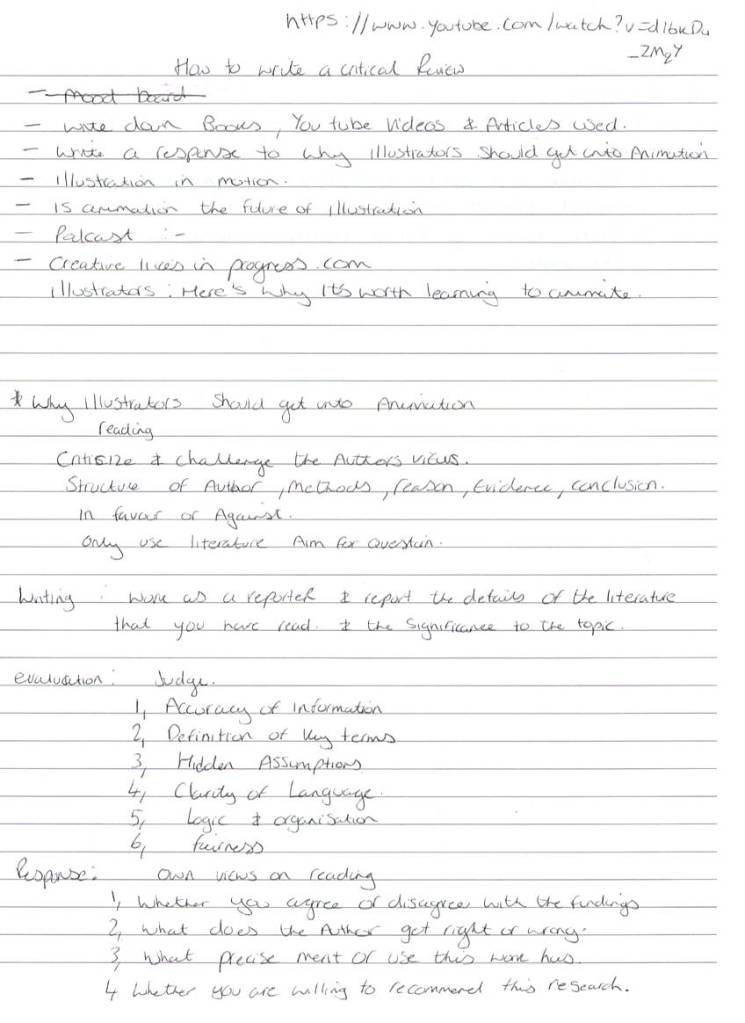
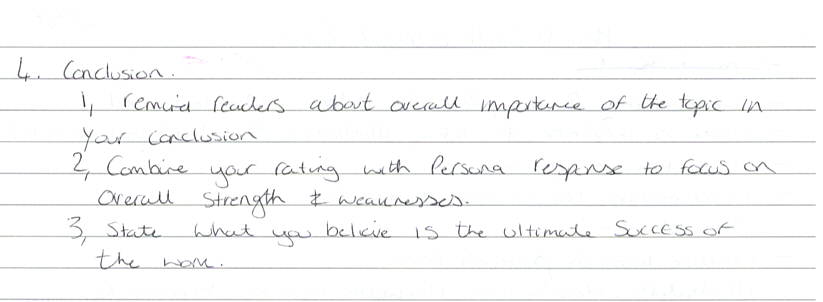
I have also included my initial ideas for the critical review, I had three ideas, one was Illustrators using animation, the second was using mixed media rather than one medium in children’s illustrations, and the third was using surface pattern design in children’s illustrations.
Now the first one related directly to the last assignment in this degree, whereas the the other two were more thoughts I was having for my children book illustration process, and working out my style.
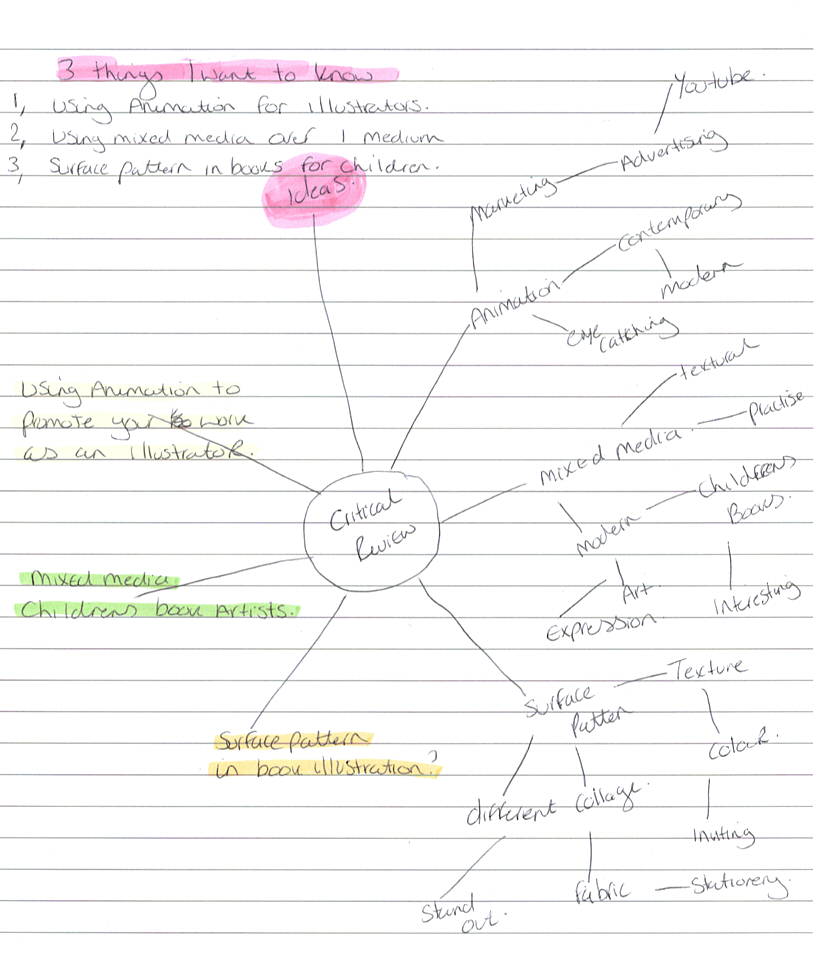
After deciding that it would be best to follow on from the last assignment so it had a direct correlation to my degree, I chose the question “Why illustrators should get into animation”, this is a re-worked question from the one above, I have refined it as advised by my tutor.
I have worked on a small mood board which I pinned some ideas to on Pinterest:-
I have looked into some articles :-
https://www.creativelivesinprogress.com/article/illustrators-learning-to-animate.
https://theaoi.com/2021/05/28/illustration-in-motion-with-linn-fritz-and-panimation/.
ICON Reax, Part 1: Is Animation the Future of Illustration?
You Tube videos:-
Leigh Ellexon – https://www.youtube.com/results?search_query=Leigh+Ellexon
Illustration websites:-
Lydia Hill – https://lydiakahill.com
Books:-
Animation for beginners by More Meroz
How to create animation in 10 easy lessons by William Bishop-Stephens
Cartoon academy cartoon faces by Christopher Hart
Review:
Lee, Giacomo (2019). Why (and how) illustrators should get into animation?
Jelly London on why illustrators need to start thinking about all things Gif, motion and animation related.
The last few years have seen a rise in digital work by Illustrators with the development of App’s and software which is easily used and attainable to everyday people. drawing on the IPad and Procreate as well as the revolution of social media to promote your work.
There is no doubt that technologies have improved immensely and has given traditional artists and illustrators a new way to work and experiment with media.
This article interviewing Chris Page from Jelly London; Giacomo states ” If looking for a barometer in illustration trends, one only needs to look towards the AOI World Illustration Awards held every year in London. Its 2019 celebration of all things illustration saw more animated pieces among the shortlist and winning entries, all still falling under that wide and inclusive bracket of illustration”.
Pictoplasma conferences and festivals have seen this clear trend for a while now, although illustrators that are new are just finding out about this.
As founder of Jelly London, Chris has been in prime position to see the adoption of idiosyncratic art for purposes of marketing and branding, and prescient enough to encourage the merging of illustration and animation as far back as the 2000s”.
Head of animation George Coffey of Jelly London’s in house animation studio ‘Kitchen’ tells us how new illustrators can start in animation and where to start. “A gif is a great way to start,” begins George by email. “We use the term gif because of its file type, but essentially it’s a very short piece of animation. It’s the best way to start because you can try out any of the techniques of animation and it’s easily shareable.”
As a newish Illustrator it’s interesting to find out from professionals how they would recommend to start in animation. I have found in the last year that a lot more illustrators and artists that I look into and follow, have turned to animation, whether just to experiment and try it out for themselves, or to actually create some body of work, promote themselves or move into an new arena.
But is this something that all illustrators should get into? Will it become the thing to do to promote and advertise yourself?
Will it work for traditional artists as well as digital artists?
I work more with traditional media and I do find it harder to animate my work, compared to digital or vector based artists. I looked into an artist I follow Leigh Ellexon a traditional artist to see how her Gif’s turned from traditional into digital work.
Leigh Ellexon is an artist and illustrator from Cincinnati Ohio USA, she works full time creating art, running her online shop, working on her You Tube channel and running a Patreon. Leigh does tutorials on art and art processes for her channel and Patrons. Leigh has a very loose style of painting and making art, she uses gouache, watercolours, acrylics and digital media for her work. Leigh changes her media from time to time and just works on one at a time, at the moment its gouache paint, although she does use mixed media in her sketchbooks.

Leigh used her traditional work as a background layer for her digital drawings for her Gif’s, she painted over them with the digital brushes, so she could keep the majority of the work the same, but traced it with digital media.
So as an illustrator what does Giacomo suggest we do?
Giacomo asks Chris how should illustrators get started? Chris states “From a technical viewpoint, I think it’s important to think about workflow as early as possible,” Chris tells me when asked why illustrators need to get animation ready.
“Anything that saves time in illustration and animation can’t be overlooked. So helping illustrators think about the way that they format their files so they can collaborate with animators easily and more effectively is very important for everyone.”
Giacomo ask’s is it necessary for an illustrator to be able to animate? “From where I’m standing,” George adds, “as someone involved in the commercial side of things, it’s really important that illustrators realise just how important animation is becoming in the marketplace.
“There have been numerous surveys recently published telling commissioners how much more effective animated billboards and interactive sites are at retaining interest customers.
So because the animation has movement in it, it makes it more eye catching and keeps the viewers concentration longer than maybe a static piece of work/ art.
Another major concern of mine and what Giacomo ask’s Chris and George; what are the challenges faced by illustrators getting into animation?
George’s response is helpful, and outlines ways that can work for us.
“I think it’s all in the mind set,” George says when I ask what challenges illustrators may face when moving into animation. “It’s all about thinking about how you prepare your illustrations, so that you have the things that you want to move existing separately.
“Illustrators are so good in showing movement with a single image, but when you’re animating it, you may find you don’t need as much detail.'”
It’s interesting to find out a different way of looking at things, and getting some feedback directly from an animator helpful in knowing how to work with animation. George goes on to comment about files sizes “File sizes are something else to think about. You won’t need to make them 300dpi at 4000×6000, you only need 72dpi 1920×1080.”
This sort of advice is really helpful for an illustrator new to animation, knowing that your file sizes can be minimised to create the work, makes it a lot easier to send work as well as keep work.
There are some problems however, with Giacomo’s argument and initial question, but he does ask Chris “One of these concerns are how much an illustrator should charge for an animation?
But Chris does answer this question “This is really important and potentially quite a big minefield for any illustrator, especially one without representation,” he writes. “I am currently involved in an initiative with the AOI (Association of Illustrators) and the APA (Advertising Producers Association) to try and reach an accord where there is wider access to a common rate of IP rates for animation use.
With regards to Giacomo’s views on animation, there is another website article that discusses this question and his findings; Is animation the future of illustration?
ICON Reax, Part 1: Is Animation the Future of Illustration?
The argument here was a little different in outcome, the majority of the for’s and against of a group of illustrators attending the ICON 6 illustration conference. The outcome was 50/50 for and against.
The author Scott Gandell states “I agree with the speakers that the transformation from 2D editorial illustration to an animated hybrid online is the future. When the job calls for the process, illustrators need to be capable-ready to produce an eye catching, click stopping, reader grabbing piece of genius … that moves”.
One of the attendees Steve Simpson an illustrator states against “Whatever it’s called, I really hope it’s not called animation! Animators are primarily focused on telling a story through movement and are aided by sound effects, music, and voice. It’s usually a collaborative process, and often takes months and years to finish a project. Illustrators are very much individuals: one-man shows that can effectively communicate ideas via mark-making alone. Two very different skills and mind sets”.
Another attendee Barbara Kosoff an illustrator and designer states for the progression “Must illustrators move towards animation as was suggested by some on the panel? Fortunately from my perspective, there were several panel discussions and speakers over the next two days who inspired many illustrators – myself included – because they still believe in the power and magic of the “static” image. Should we consider animation? Of course. In fact, in my own work, I have already begun exploring a series”.
A third attendee Nargol Arefi an illustrator states against “Reading” an animated story, even at its best, resembles watching a movie, a much more passive behaviour. But reading an illustrated story actively involves each reader’s unique – and limitless – imagination”.
A fourth attendee Katy Betz an illustrator states “I think we lose more than we gain by abandoning the printed page in favour pf animated illustrations on mobile phones and iPads. Active imagination will be numbed by passive entertainment, and the contemplative moment killed by bells and whistles.
I can see how the illustrators and designers against animation feel, and can see how this would affect our long term idea of an illustrator and what they do. One of the resigns I got into illustration was because of traditional media, and the excitement I feel for the texture and process.
looking at another article from The AOI;
https://www.theaoi.com/2021/05/28/illustration-in-motion-with-linn-fritz-and-panimation/
The author writes “In an age where everyone has been forced to stay in and stay safe, the need for connection and technology has never been so important. With a boom in gadget use over the last year of the pandemic, the need from clients to commission animated content that will stop people in their tracks is booming too. Although animated content is in high demand, Illustrators are often left feeling daunted by the task of making the static come to life through motion”
The author interviews Linn Fritz and ask’s the question “In your eyes, what is the future of illustration/ animation”?
Linn states “Over the last couple of years we have seen a shift in the media landscape – Our attention span keeps on getting shorter and so do the deliverables for a lot of creatives. I have almost completely shifted my focus to animated gifs and quick turnaround jobs with tight deadlines and personally, it suits me so much better. I thrive on a short deadline and tend to produce better work when I literally don’t have time to get distracted”.
Conclusion
So why should illustrators get into animation?
So from the article by Giacomo Lee the answer would be that it is the way forward, animation has boomed in illustration over the last few years, it’s more attainable and easier to use, it would develop your experience as an illustrator and would benefit your career.
You can see by the comments made that the findings and feedback and growth in this area has developed, and seems to be the most sort after medium to use, especially for marketing, advertising and to get your ideas across quickly & communication.
This is supported in some way by the article from Printmag where the illustrators and organisers of the ICON 6 conference agree 50/50 that this is the way forward.
Also from the article from The AOI that Linn Fritz also see’s the benefit and future of illustration in this way.
Going back to the article from Printmag though there is still and also a good argument of why this could be bad for illustrators and their careers. Not being known as illustrators anymore, maybe animators or visual communicators! Not using or having traditional mediums used as much, having such a passive way to communicate all the time, being too similar to films, videos and movies!
Loosing that traditional feeling of a static image, and reading what you will through it. Using your imagination to fill in the gaps in, rather them being filled for you. Not having to work as much, your brain loosing its muscles in thinking about the artwork, it all being done for you, you just have to sit back and watch it.
But I do think that a fellow attendee from the ICON 6 conference made a valid point; Aileen Holmes illustrator and designer “Technology offers exciting opportunity and new ways to offer illustration to the world. Movement is one possible avenue for innovation of the millions not even conceived yet. Still, the public craves raw visual images created by the human hand. Art transcends time and will always be desired”.
I do agree with that comment and believe that illustrators are more likened to artists, but still see that having learnt animation, that it can only help with not least understanding another media form, and learning new things is always the future. Looking at the great artists of our time and back in the past, we still all look to those for inspiration and knowledge, I don’t think that will change in the future, the traditional methods will always be there, even if they come around again in the future, what goes around comes around.
I think Giacomo’s article is a good article for new illustrators, it gives behind the scenes knowledge and advice from Chris and George. It also offers opinions and how you can start in animation and how this might help your career and future as an illustrator, so yes illustrators should get into animation.
Bibliography
https://www.creativelivesinprogress.com/article/illustrators-learning-to-animate.
https://www.theaoi.com/2021/05/28/illustration-in-motion-with-linn-fritz-and-panimation
ICON Reax, Part 1: Is Animation the Future of Illustration?
Ellexon L (2020) Giphy animation [digital]
 ruthgoodwinsillustration.home.blog